ClickUp gets recommended constantly, and almost every guide skips the question that actually matters: Does the free plan hold up for real daily use, or does it quietly push you toward a paid tier the moment you get comfortable?
I looked at this from the angle of someone who already tried simpler tools and hit a wall. Not a beginner building their first to-do list.
Someone who outgrew sticky notes and basic reminders and needs something that handles recurring tasks, shifting priorities, and multi-device access without requiring a project management degree.
That is a specific gap. Most ClickUp guides do not address it directly.
The Setup That Actually Works for Daily Use
The most common ClickUp mistake is treating it like enterprise software from day one. New users open the app, see the sidebar full of Spaces, Folders, Lists, and Views, and immediately start building a system elaborate enough to manage a 20-person team.
For a solo daily workflow, that is a significant amount of overhead for zero benefit.
Start with one workspace, one list, and the default list view. That combination covers 90% of daily personal task management without customization.
Add tasks as they come in. Do not wait until you have a perfectly structured system before capturing work. The friction of an unfinished setup is exactly what makes people abandon new tools within the first two weeks.

Why One List Outperforms Five Separated Ones
Splitting tasks across multiple lists feels organized in theory. In practice, it creates a daily navigation problem. You open ClickUp, check List A, check List B, miss something in List C, and now the tool requires active management instead of supporting passive awareness.
A single prioritized list with color-coded labels for category gives you separation without the navigation overhead. Use priority flags for urgency. Use due dates sparingly: only on tasks that genuinely have a deadline, not as a way to make every item feel important.
The ClickUp Free Plan Limit Most Guides Skip
I was skeptical about the free plan being enough until I checked the actual feature breakdown. ClickUp’s free tier includes unlimited tasks and unlimited members, which already puts it ahead of several competitors who cap task counts.
The practical limit hits at storage: 100MB total on the free plan. For pure task management with no file attachments, that ceiling is effectively invisible.
The moment you start attaching documents, screenshots, or project files to tasks, that limit becomes real within a few months of active use.
If your daily workflow involves attaching files directly to tasks, budget for the Unlimited plan. If tasks stay text-based with occasional links, the free plan holds up without compromise.
Building a Daily Routine That Does Not Collapse by Thursday
The most common reason productivity systems fail is not tool selection. It is that the routine was designed for a best-case day and falls apart the moment anything goes sideways.
My contrarian take: designing your daily task review for your worst possible day is more important than optimizing it for your average one.
Most productivity guides build workflows that assume you have 20 uninterrupted minutes each morning. If that assumption breaks once, the habit breaks with it.
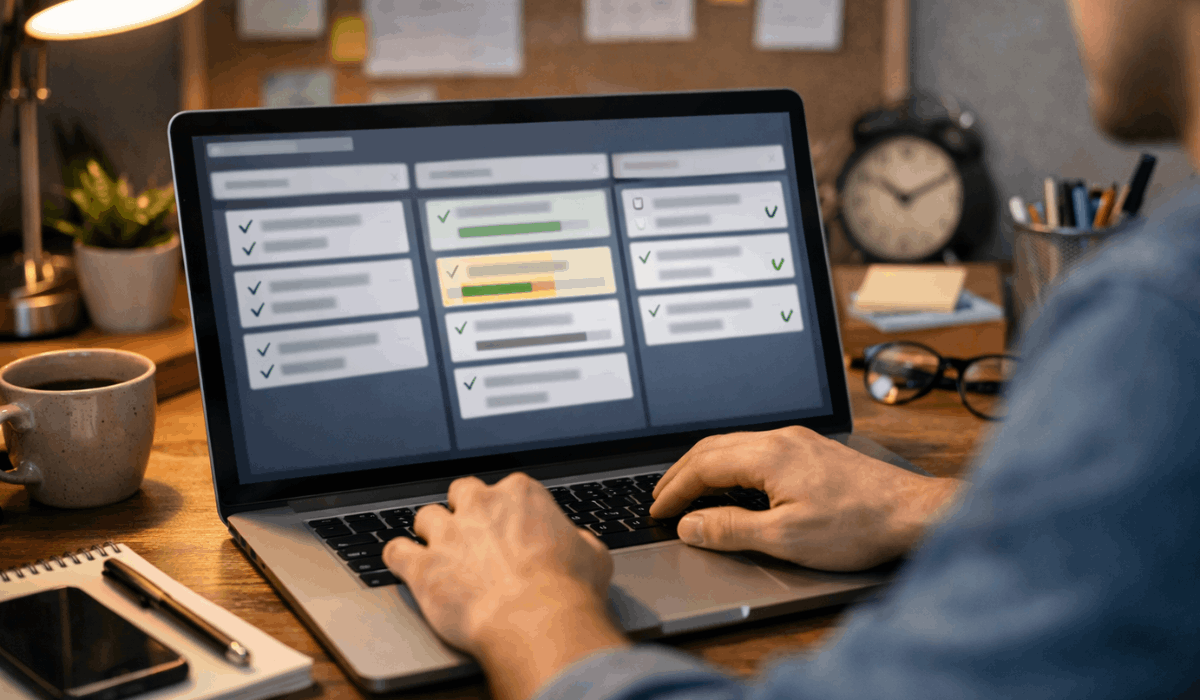
A ClickUp daily routine that holds up under pressure looks like this:
- Morning check-in under 3 minutes: Open your single list, scan active tasks, flag the top three priorities for the day
- Mid-task updates in under 30 seconds each: Change status as work moves forward. No notes required unless something blocked you
- End-of-day close in under 2 minutes: Mark completed tasks done, move anything unfinished to tomorrow
The entire system runs on about five minutes of deliberate interaction per day. If your productivity system requires more daily maintenance than that, it is managing itself rather than managing your work.
Also read: Canva, Grammarly, and Zoom Free Plans: Where They Actually Break Down
Notifications: Turn Off More Than You Think
ClickUp’s default notification settings assume you want to know about everything as it happens. For daily personal task management, that assumption is wrong.
Turn off all real-time notifications except deadline reminders. Check your task list at scheduled times rather than reacting to every alert. This is not a minor preference adjustment.
Constant task-app notifications create the same context-switching problem they are supposed to solve. You spend attention managing the tool instead of doing the work the tool is tracking.
ClickUp Across Devices: Where It Works and Where It Wobbles
The desktop experience and the mobile experience are not identical, and that gap matters for daily use.
Desktop ClickUp is where planning happens. The full sidebar, multi-pane views, and keyboard shortcuts make it genuinely fast for building out your task list, setting priorities, and reviewing progress across everything active.
Mobile ClickUp is where quick captures and status updates happen. Adding a task while away from your desk, marking something complete between meetings, and checking what is due today. The mobile app handles these interactions cleanly.
Here is what the device split looks like in practical terms:
| Action | Best Device | Why |
|---|---|---|
| Building or reorganizing task list | Desktop | Full view, faster navigation |
| Quick task capture | Mobile | Faster to grab than opening laptop |
| Status updates | Either | Equally fast on both |
| Reviewing priorities for the day | Desktop | Better visual overview |
| Marking tasks complete on the go | Mobile | Immediate, no desk required |
The sync between desktop and mobile is reliable. Changes made on one device appear on the other without manual refresh, which is the baseline requirement for any cross-device tool to function in a real daily workflow.
Who ClickUp Daily Task Mode Actually Fits
This stripped-down ClickUp approach works specifically for a certain kind of user. It does not work for everyone, and acknowledging that upfront saves people a frustrating onboarding experience.
It fits well for:
- Remote and hybrid workers tracking a mix of independent tasks and team follow-ups without formal project management software
- Students managing coursework, deadlines, and reading lists who need more structure than a notes app but less overhead than a full project tool
- Freelancers juggling multiple client work streams who need one place to hold everything without paying for project management software
It does not fit well for:
- Users who need advanced automation built into their daily workflow from the start
- Large teams requiring role-based permissions and approval chains
- People who genuinely prefer unstructured, ad-hoc task capture and find any system constraining
The wrong fit is not a failure of the tool or the user. It is a mismatch that most guides paper over with generic enthusiasm instead of acknowledging it directly.
Questions People Ask About Using ClickUp for Daily Tasks
Q: Is ClickUp overkill for a simple personal to-do list? For a basic daily list of five to ten tasks, yes, it probably is. A simpler app like Todoist or even Apple Reminders handles that without the learning curve. ClickUp earns its place when your task volume grows, you need cross-device reliability, or you want to eventually scale into team collaboration without switching tools.
Q: How long does ClickUp take to set up for basic daily use? Under 15 minutes for a functional starting setup. Create one workspace, add one list, and start dropping tasks in. The elaborate configurations you see in tutorial videos are optional and can be ignored entirely during the first month.
Q: Does ClickUp work offline? The mobile app supports limited offline access, allowing you to view and update existing tasks without a connection. New tasks are created offline and sync when the connection is restored. The desktop app requires an active connection for full functionality.
Q: Can I use ClickUp alongside Notion or Trello instead of replacing them? Yes, and many people do. A common setup uses ClickUp for active daily tasks, Notion for reference notes and documentation, and reserves Trello for shared visual pipelines with external collaborators. Overlap exists, but the workflows are different enough to justify running two tools if both are genuinely used.
Q: What is the biggest mistake people make when starting ClickUp? Building too much structure before adding a single real task. Set up the minimum viable workspace first. Get your actual work into the system. Organize and refine once you understand how your tasks actually behave in the tool, not before.
Conclusion
A good task management system should require less daily attention over time, not more. Start with the smallest ClickUp setup that captures your real work, use it consistently for two weeks, and only then decide what structure it actually needs.
The tool adapts to how you work. The only question is whether you give it enough time to prove that before adding complexity that was never necessary.