That breach notification email sitting in your inbox is doing something to your brain right now. It is making you question every password you have ever recycled.
And that nervous feeling? It is the right instinct. Learning to store passwords securely starts with exactly that kind of discomfort.
The problem is that half the advice online tells you to do everything at once. Switch managers, change every login, set up two-factor authentication on 47 accounts before lunch.
A calmer approach works better. This breaks down your real options for password storage, what each method costs you in effort, and which traps to skip entirely.
Comparing Your Password Storage Options in 2026
Three main methods cover the way people store passwords securely right now, and each one carries trade-offs that rarely get mentioned in the same sentence.
The best pick depends less on which tool is “safest” and more on which system you will consistently use six months from now.
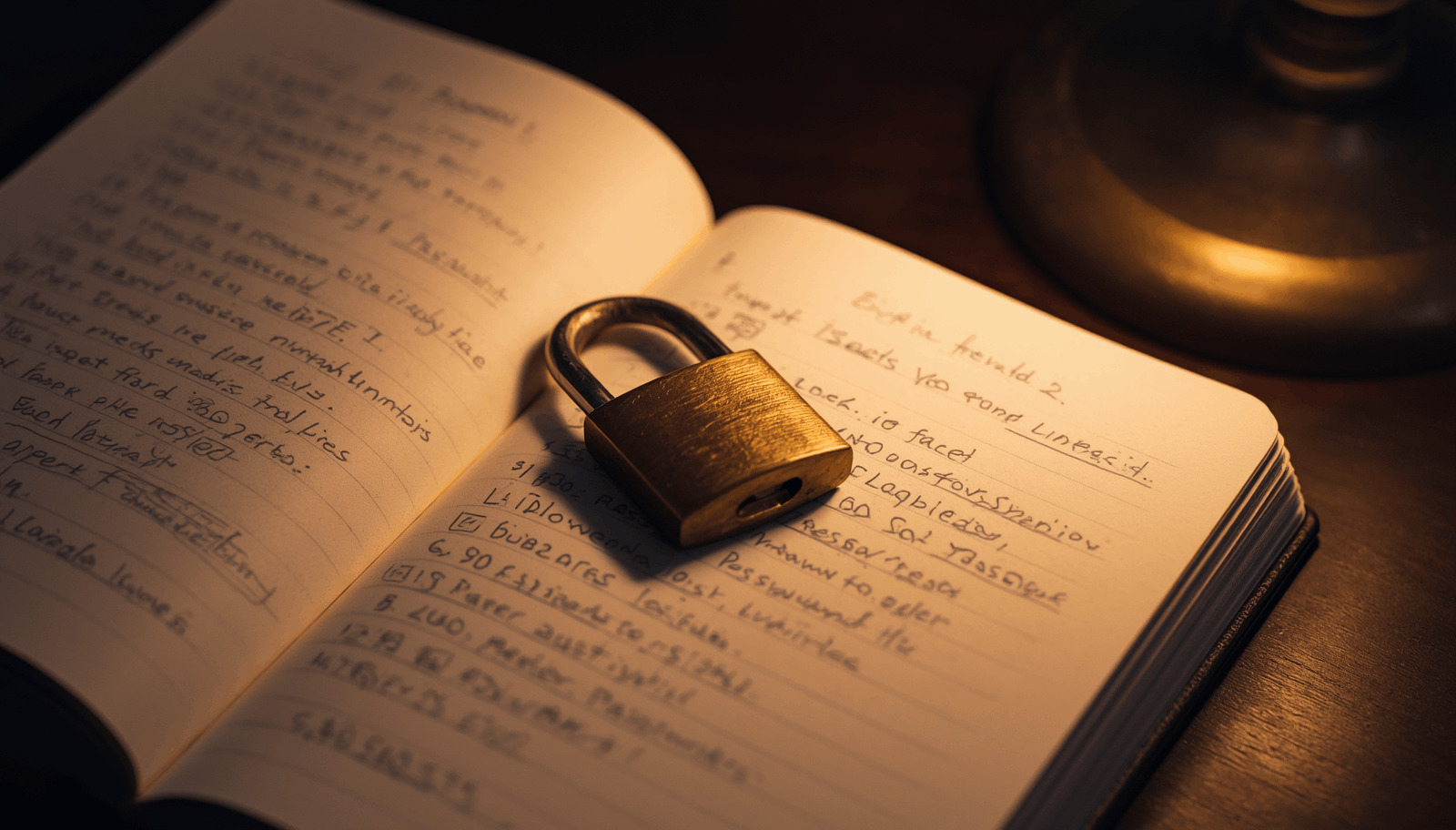
That consistency factor is the part that gets glossed over constantly. A perfectly secure method that you abandon after a week is worse than a decent method you stick with daily.
| Feature | Password Manager (Bitwarden, 1Password) | Paper Notebook | Encrypted File (VeraCrypt, BitLocker) |
|---|---|---|---|
| Protection against online attacks | Strong (end-to-end encryption) | Complete (no digital footprint) | Strong (depends on master password) |
| Risk if lost or stolen | Low (cloud backup, master password needed) | High (no recovery possible) | High (no recovery without master password) |
| Ease of daily use | High (autofill, cross-device sync) | Low (manual lookup every time) | Medium (requires opening and decrypting) |
| Setup effort | Moderate (import passwords, learn interface) | None | High (software installation, encryption setup) |
The takeaway: password managers win on daily convenience, but paper notebooks carry zero online attack surface. Pick based on your weakest point, not the “best” overall rating.
Password Manager Apps Like Bitwarden and 1Password
Password managers store all your credentials behind one master password and encrypt everything so that even the company running the service cannot read your data.
Bitwarden and 1Password are the two names that come up the most in 2026, and for good reason.
Bitwarden runs on an open-source model, meaning its code is publicly auditable.
1Password takes a different route with a Secret Key system layered on top of the master password, adding a second barrier that makes brute-force attacks dramatically harder. Both sync across phone, laptop, and tablet.
The part nobody prepares you for is the migration process. Importing passwords from Chrome or Safari into a dedicated manager takes time, and during that transition period, you are running two systems at once.
I would estimate the migration window for someone with 50+ saved browser passwords at Bitwarden takes a solid weekend of focused effort to clean up duplicates and update weak credentials.
The Paper Notebook Method Still Works
Paper sounds ridiculous until you think about it for ten seconds.
A physical notebook stored in a locked drawer at home has zero exposure to ransomware, phishing, or server breaches. No hacker on the planet can remotely access a piece of paper in your nightstand.
The obvious downside: lose that notebook, and there is no “forgot my password” button. Fire, water damage, or a curious houseguest can wipe out your entire system overnight.
This method can be suitable for people managing fewer than 10 accounts. Keeping a handwritten list of bank, email, and a few shopping logins is manageable.
Once that number climbs past 15, the notebook becomes a bottleneck that slows down every single login.
Encrypted Files on Your Computer
A less common approach uses software like VeraCrypt or BitLocker to create an encrypted container file on your hard drive. Think of it as a locked vault on your desktop. The file looks like gibberish to anyone without the master password.
This method sits between a password manager and a paper notebook in terms of both security and hassle. The encrypted file lives offline (or wherever you store it), which limits exposure. But if you forget the master password, recovery is nearly impossible.
I think VeraCrypt is underrated for someone who already handles file management on their computer daily, since the workflow fits naturally into how they already use their device.
The catch: it does nothing on your phone unless you manually carry the file over, which defeats the point for most people.
Habits That Make Password Storage Safer
A storage method is only half the equation. The daily habits around that method determine whether your passwords stay protected or quietly leak out over months.
These three habits create the widest gap between people who get hacked and people who don’t.
Stop Reusing Passwords Across Sites
Password reuse is the single fastest way to turn one breach into five.
When a smaller site gets compromised and your email-password combo leaks, attackers run that same combination against Gmail, Amazon, banking portals, and social media within hours.
Automated tools called credential stuffing bots do this at scale.
The fix is straightforward but annoying: every account gets its own unique password. A password manager handles this automatically by generating random strings.
A notebook user writes each one separately. Either way, the habit matters more than the tool.
Setting Up Two-Factor Authentication
Two-factor authentication (2FA) adds a second verification step after your password.
A code arrives via text message, an authenticator app like Google Authenticator or Authy generates a time-based code, or a biometric scan confirms your identity.
The text message method is the weakest form of 2FA because of SIM swapping attacks, where someone convinces your carrier to transfer your phone number. Authenticator apps remove that vulnerability entirely.
Getting 2FA running on your email account and banking apps should be the first two accounts you protect, since those two unlock almost everything else.
Plain Text Password Files Are a Trap
A surprising number of people keep a file called “passwords.txt” on their desktop or email themselves a list of logins. Both methods leave credentials completely exposed if a device gets stolen or infected with malware.
The risk here compounds quietly. One compromised device, one email account breach, and every credential in that plain text file is available to whoever got in.
An encrypted note app on your phone, even Apple Notes with the lock feature or Samsung Secure Folder, gives a baseline level of protection that a bare text file never will.
What Happens When Password Storage Fails
The consequences of weak password storage tend to cascade. One account breach rarely stays contained to that single account, and the knock-on effects can take months to clean up.
Account Takeover and Social Engineering
If someone accesses your email through a stored password, they can reset passwords on nearly every connected service.
Social engineering takes this further: attackers who already have some of your credentials can call customer support and impersonate you using the details they found.
A stolen password is a starting point for deeper access. Bank accounts, cloud storage, and social media profiles are all reachable once an attacker controls your primary email.
This is why I would prioritize locking down email and banking logins at Google Account Security before anything else.
Identity Theft and Financial Damage
Identity theft stemming from password breaches cost U.S. consumers roughly $10.2 billion in 2023, according to the FTC’s most recent published consumer sentinel data available through FTC Reports.
Stolen credentials are one of the primary entry points for identity fraud.
The financial cleanup can take months. Freezing credit reports, disputing fraudulent charges, and replacing compromised documents all stack up into a process that consumes far more time and energy than setting up proper password storage would have taken.
Features Worth Checking in a Password Manager
Not every password manager deserves your trust. If you do go the manager route, a few features separate the reliable options from the forgettable ones:
- End-to-end encryption: the provider should have zero ability to view your stored passwords, even if law enforcement requests access
- Cross-device sync: your passwords need to be available on your phone, tablet, and computer without manual transfers
- Password generation tools: built-in generators create random, high-entropy passwords that are nearly impossible to guess
- Breach monitoring alerts: services like Bitwarden and NordPass now scan known breach databases and notify you when a stored credential appears in a leak
- Secure sharing: some managers let you share a login with a family member or coworker without ever exposing the underlying password in plain text
My contrarian take on this: I think the common advice to “just get a password manager” misses a huge problem. For someone with only 5-8 accounts, Bitwarden or 1Password introduces more complexity than it solves.
A locked note in Apple Notes or Samsung Secure Folder, encrypted at the device level, handles that small number of credentials without adding another master password to remember, another app to update, and another company holding your data.
A second set of habits keeps the storage method healthy over time:
- Review stored passwords quarterly and remove accounts you no longer use
- Change your master password every 12 months if your manager does not enforce rotation
- Test your recovery process at least once so you know it works before you need it
Questions People Ask About Storing Passwords Securely
Q: Are free password managers safe to use?
Some free options, like Bitwarden’s free tier, have passed independent security audits and provide solid encryption. The trade-off tends to show up in features like limited device sync or no breach alerts rather than in weak security architecture. Check the audit history before trusting any free manager.
Q: What happens if I forget my master password?
Losing the master password to a manager like Bitwarden or 1Password typically means losing access permanently. A few managers offer emergency recovery kits or backup keys generated during setup. Store that recovery information separately, perhaps on paper in a secure location, so a single failure does not lock out every account.
Q: Is it safe to let my browser save passwords?
Browser password storage is better than reusing the same password everywhere but weaker than a dedicated manager. Chrome and Firefox encrypt stored passwords, yet device theft or a malware infection can expose them. Anyone who shares a computer should avoid browser password storage entirely.
Q: How often should I change my passwords?
Routine password changes every 30 or 90 days are falling out of favor because they encourage people to pick weaker, easier-to-remember passwords. Changing a password after a confirmed breach or suspicious activity matters far more. NIST guidelines since 2017 have recommended against forced periodic rotation for this exact reason.
Q: Can I use the same master password for everything?
A single master password for your password manager is the whole design. But using that same master password as your email or banking login defeats the purpose. The master password should exist in exactly one place: your password manager’s login screen. Nowhere else.
Conclusion
The way you store passwords securely in 2026 depends less on finding the “best” tool and more on picking one you will stick with.
A locked notebook, an encrypted note, or a full password manager all beat the default of reusing “Fluffy123” on 40 sites.
The small effort of switching now saves the much larger effort of cleaning up after a breach later. Start with your email and banking logins this weekend, and build the rest of the habit from there.